
For over ten millennia of the farming era, most folks saw themselves as tightly tied to small groups that lived in a largely alien and hostile world, under the thumb of empires and elites selected by tradition and power, elites not embarrassed by their privilege, interested in the general welfare, nor open to persuasion by argument. Few saw grand arcs of history as the sorts of things that they could or should much influence.
Today, in contrast, most people and especially elites see themselves as part of a single big world, with elites selected more by merit, embarrassed by unmerited privilege, interested in general welfare, and especially smart and open to persuasion. So we see world arcs and problems as things to be dealt with by smart elites talking stuff out until they agree, and most everyone is eager to join in such talk to seem like elites.
How did this change? In 2010, I started to explore this explanation: modern values are mainly a reversion to forager values.
[Forager] individuals who otherwise would be subordinated are clever enough to form a large and united political coalition. … the weak combine forces to actively dominate the strong. … They must continue such domination if they are to remain autonomous and equal, and prehistorically we shall see that they appear to have done so very predictably as long as hunting bands remained mobile. … Before twelve thousand years ago, humans basically were egalitarian. They lived in what might be called societies of equals, with minimal political centralization and no social classes. Everyone participated in group decisions, and outside the family there were no dominators. For more than five millennia now, the human trend has been toward hierarchy rather than equality. But the past several centuries have witnessed sporadic but highly successful attempts to reverse this trend. (More)
A lot of today’s political disputes come down to a conflict between farmer and forager ways, with forager ways slowly and steadily winning out since the industrial revolution. It seems we acted like farmers when farming required that, but when richer we feel we can afford to revert to more natural-feeling forager ways. (More)
In the absence of [big] threats, the talky collective was the main arena that mattered. Everyone worked hard to look good by the far-view idealistic and empathy-based norms usually favored in collective views. … When they felt on good terms with the group, people could relax and feel safe. They then become more playful, and acted like animals generally do when playful. Within a bounded safe space, behavior becomes more varied, stylized, artistic, humorous, teasing, self-indulgent, and emotionally expressive. For example, there is more, and more varied, music and dance. New possibilities are explored. (More)
We [today] … have a strong world culture of regulators, driven by a stronger world culture of elites. Elites all over the world talk, and then form a consensus, and then authorities everywhere are pressured into following that consensus. … This looks a lot like the ancient forager system of conflict resolution within bands. Forager bands would gossip about a problem, come to a consensus about what to do, and then everyone would just do that. … This world system [is] new … this looks like another way in which our world has become more forager-like over the last few centuries, as we’ve felt more rich and safe. (More)
Weak cultural selection pressures have allowed a drift back to forager habits and attitudes, which DNA makes still more natural than farmer alternatives. Our increased wealth, health, and peace now makes us unusually willing and able to indulge forager-style moral preferences. The usual forager view is this: we must coordinate via norms and governance to prevent dangerous competition from undermining our precious stable shared human values. (More)
I don’t claim to be totally original here. Let me credit sources who explored related ideas: Joshua Meyrowitz (1986) No Sense of Place, Friedrich Hayek (1988) The Fatal Conceit, Ernest Gellner (1994) Conditions of Liberty; Christopher Boehm (1999) Hierarchy in the Forest; Ronald Inglehart, Christian Welzel (2005) Modernization, Cultural Change, and Democracy; Peter Turchin (2105) Ultrasociety; Ian Morris (2015) Foragers, Farmers, and Fossil Fuels; James Suzman (2020) Work.
To test this basic idea, I asked 3 LLMs to find 100 cultural changes in the West in each of the periods 1400-1726, 1726-1826, 1826-1926, and 1926-2026, and then to score each change as more toward a forager style, more toward a farmer style, or hard to classify and thus neither. Here are their results:
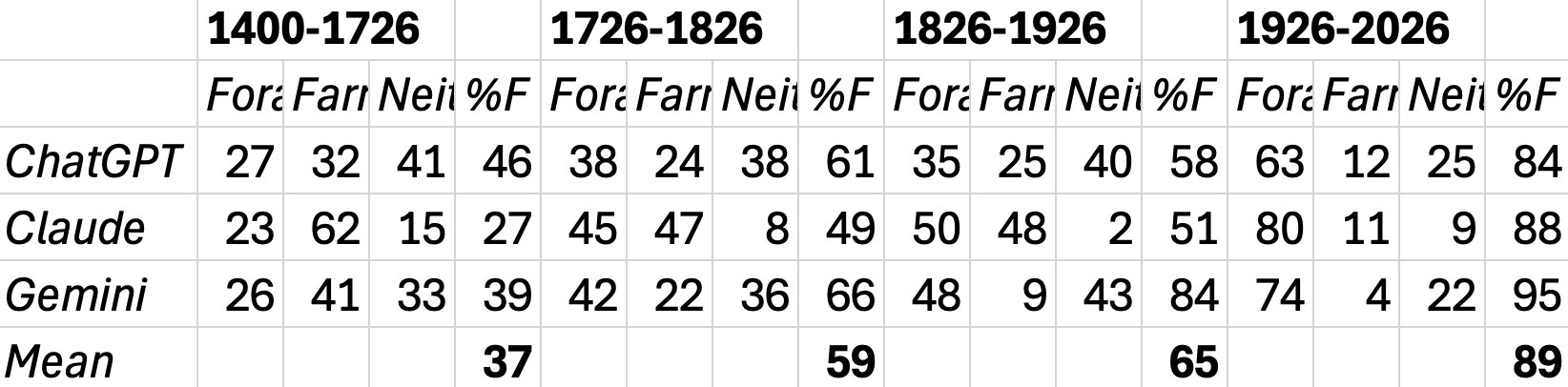
For the last century, we see a strong correlation: averaging over LLMs, 89% of culture trends that can be classified are toward-forager. Making this return-to-forager-styles theory quite explanatory for that period. However, over the prior two centuries the correlation seems real but weaker, with 59% and then 65% of trends being toward-forager. For the earliest period of 1400-1726, the tendency was the opposite, with only 37% of trends were toward-forager.
To explain recent trends even better, let’s add in two more key changes: the world got both better connected and more educated. Increasing talk, travel, and trade made us intuitively feel part of much larger communities. So when our elites try to act like forager sitting around the campfire pontificating on their band’s problems, they see much larger social units as their “band”, often the whole world. And being better educated, elites now use much higher levels of abstraction and other mental tools of the educated when pontificating on big arcs and problems. Also, putting our young elites together in school has created strong youth cultures, which have for the last century driven rapid change in core cultural values.
This return to forager styles has created the intellectual world that I have known and loved all my life. The world in which I love to read, listen, write, and speak. And which sits adjacent to the songs, movies, art, etc. that I love. A world where, at its best, smart young people talk abstractly and idealistically about big issues and problems, and then greatly influence policy and culture. In the last few decades I’ve been associated with new groups like rationalists and effective altruists who have arisen in this mold.
Alas, I recently learned that forager-style elite talky collectives seem to be contributing to our civilization’s key problem of decline due to insufficient evolutionary pressures for dimensions of behavior not greatly under the control of capitalism, but instead subject to strong individual conformity pressures. Not only have youth movements been rapidly changing key cultural values with little regard to their adaptiveness, but our forager elite intellectuals have been overconfidently inducing over-regulation, severely limiting the scope of strong evolutionary pressures.
You see, ancient forager elites didn’t just consider in general how to promote their groups, they instead focused mostly on the possibility that some of group members might gain and use dangerous powers. Since then, people thinking like foragers have similarly focused on identifying and reigning in what they see as the dangerous potentially-ineqalitarian powers of their world. In the last few centuries, such dangers have included alien ideologies and militaries, capitalist owners and firms, and technologies like nuclear, genetic engineering, and AI. A lifetime of detailed examination of such things allows me to say with some confidence: we have consistently greatly over-regulated such things.
It is likely that our civilization will fall, to be replaced by much less forager-like versions. Like civs built by descendants of today’s Amish and Haredim. But I see a chance to save a lot, a chance I want to explore. Yes, this would require substantial compromise; we just can’t keep on relying on simple forager intuitions as naively as we have. But I do see a potential way out.
First, we’d need to adopt far more effective and accountable institutions for creating consensus on claims about the concrete consequences of policies. Institutions like policy decision markets or academic prestige futures. These could cut much of the bias in our policy choices, relative to our values. Second we’d need to either directly or indirectly show far more respect for adaptiveness when expressing our deep values. Either have big polities hold to sacred goals inconsistent with civ collapse, or smaller polities hold directly to their long term adaptiveness, both via rather competent governance institutions. Big asks, I know, but at least I see a chance here.
"Before twelve thousand years ago, humans basically were egalitarian. They lived in what might be called societies of equals, with minimal political centralization and no social classes. Everyone participated in group decisions, and outside the family there were no dominators."
We know this how?
Robin, this piece pushed me to think about Indian politics in a different way.
Your “forager vs farmer” framing helped crystallize something I’ve been struggling to articulate: India’s urban educated upper middle class increasingly thinks and talks like a post-material forager elite: abstract, consensus-oriented, universalist, and technocratic while operating inside a mass democracy still driven by numbers, patronage networks, and identity coalitions.
The result is a class that is economically productive and culturally influential, yet politically weak enough to often feel treated primarily as a resource extraction base.
I wrote a short response applying your framework to the Indian context here: [https://substack.com/app-link/post?publication_id=8754954&post_id=199038672&utm_source=post-email-title&utm_campaign=email-post-title&isFreemail=false&r=2qmaa&token=eyJ1c2VyX2lkIjo0NjAxMTcwLCJwb3N0X2lkIjoxOTkwMzg2NzIsImlhdCI6MTc3OTYwMzQ0NywiZXhwIjoxNzgyMTk1NDQ3LCJpc3MiOiJwdWItODc1NDk1NCIsInN1YiI6InBvc3QtcmVhY3Rpb24ifQ.5ouirD_pmxlN8B-AyHIpVjJBKUyA_4vTSPdgr6L0G2U