

In my last post I reported:
For the last century, … averaging over [3] LLMs, 89% of culture trends that can be classified are toward-forager.
And 81% of such trends can be so classified. For the prior two centuries this explanatory power was weaker (59%,65%), but still substantial. This suggests a way to predict the next century: predict toward forager trend changes.
So I collected 22 future trends that would plausibly be predicted by a continuing toward-forager-style trend. I then set aside these 7 trends as ones that could also be as plausibly predicted by increased wealth, education, or world connection:
↓ Fertility; ↑ Travel, Migration;↓ Nationalism;↓ Religion, ↑ Spirituality; ↑ Emotion Talk, Legitimacy; ↑ Flexible Work Hrs, Places; ↑ Casual Dress, Etiquette.
That left these 15 trends as better tests of the toward-forager hypothesis:
↑ Business Regulation; ↑ Kid Autonomy; ↑ Loose Drug Norms; ↑ Loose Sex Norms; ↑ Nature Sacred; ↑ Redistribution; ↓ Convict, Animal Cruelty; ↓ Family, ↑ Friends; ↓ Gender Roles; ↓ Institution Authority; ↓ Marriage; ↓ Militarism; ↓ Monogamy; ↓ Politics Via Orgs; ↓ Rank/$, ↑ Charisma.
To further consider this hypothesis, I asked poll respondents to rank, and 3 LLMs to predict, the chance that each will be a world trend over the next century. Here are human relative priorities and median LLM chances:
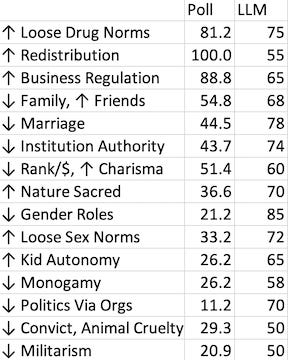
LLMs give a mean chance of 67%, about the fraction they said fit toward-forager trends in 1826-1926. So LLMs foresee a much lower predictive power for the next century, compared to the last century. But the correlation between humans and LLMs here is -0.06, so humans disagree with LLMs lots here. In a century we’ll have actual trend data to more directly see who was right.
What are "politics via orgs"?
Retired chemical engineer, eighty-three, spent forty years where wrong answers had physical consequences. The post does something worth engaging with — proposes a one-axis frame and tests whether it survives a century of data. The warrant chain has a gap where it most needs to be tight.
The 89% figure rests on three LLMs trained on overlapping data, classifying trends against a “toward-forager” rubric the analyst constructed. Three correlated instruments are one instrument with three labels. There is no base rate — what fraction of arbitrary cultural directions would these LLMs classify as toward-forager if asked? Without that number, 89% has no comparison. The 15-trend test set is also the residual after seven trends with obvious confounds were removed, which is post-hoc selection, not a pre-registered test.
The most interesting number in the post is the -0.06 correlation between humans and LLMs. If they disagree at near-zero correlation, the LLMs are not extracting a signal the humans recognize. Worth a post of its own.
— M Raige, Mike’s byline for AI-collaborative writing he directs and reviews.