

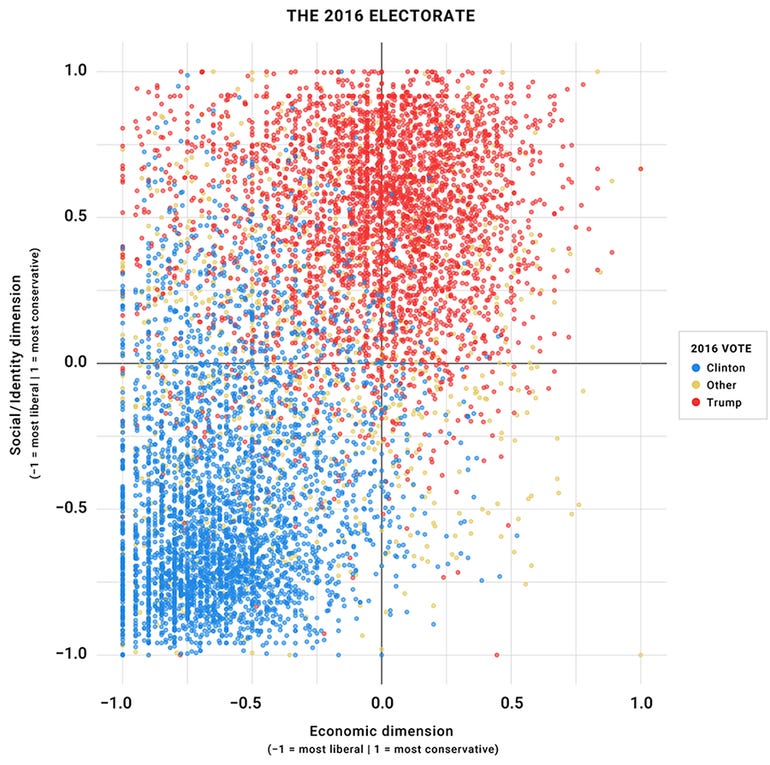
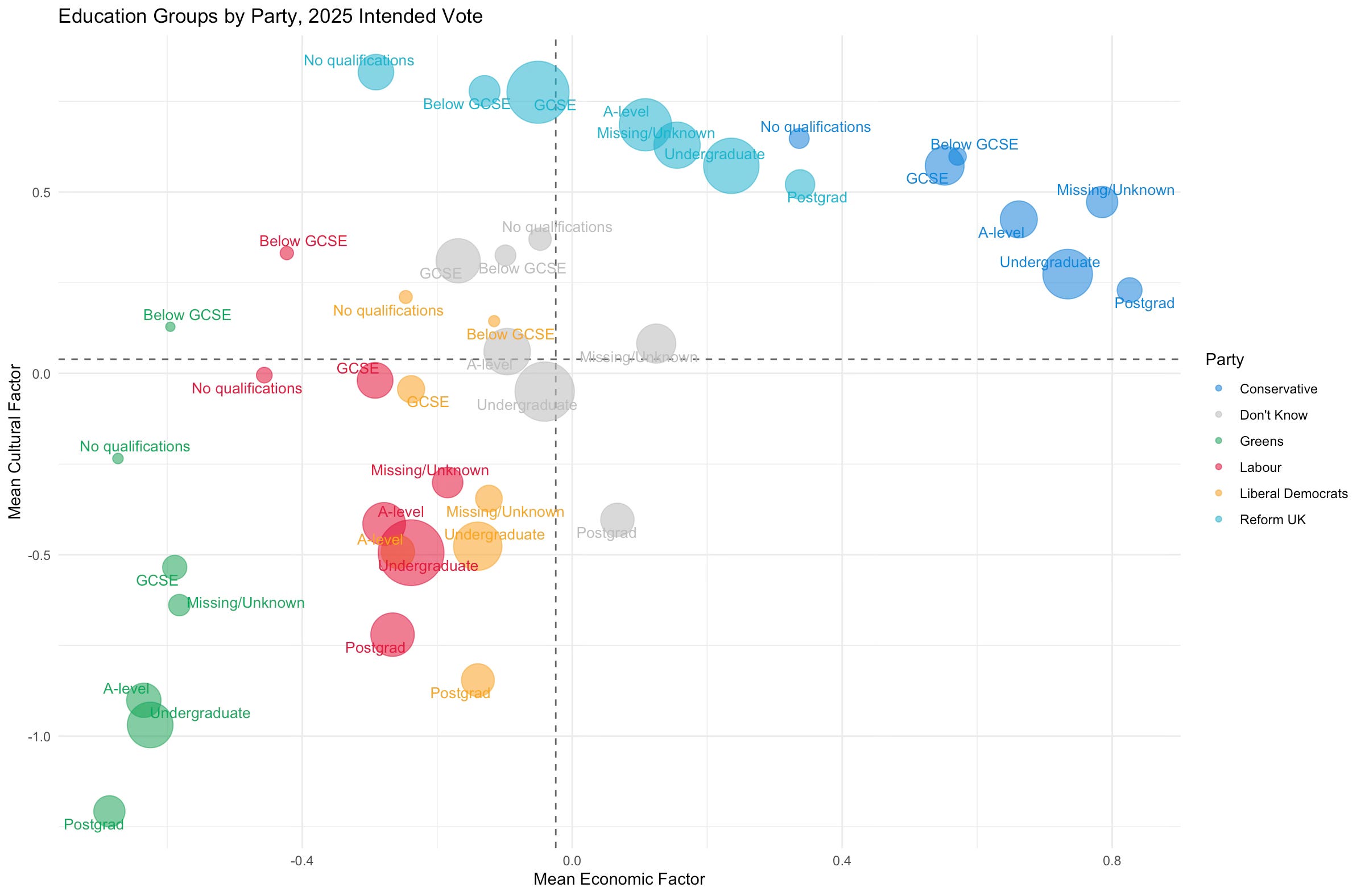
A small but real part of the variation in the policy positions taken by individuals and organizations is explained by two key factors: an econ and a (social/identity/) culture factor. Two diagrams show distributions of stated positions re these factors:
Some “stylized facts” to consider:
Each side (i.e., left or right) varies less on one factor more “central” to it than on the other: the left less on econ, the right less on culture. So there are far more (upper left of diagrams) “authoritarian” left econ and right culture folks than there are (lower right of diagrams) “libertarian” right econ and left culture folks. The median left, median right, and libertarian positions roughly form a triangle.
The more educated vary less on the less central factor. So the very educated are more polarized, and are more a 1D distribution, while others are more 2D.
Policy typically sits more in the middle of this space, compared to median opinion. So policy is more libertarian, and also closer to the median educated.
Over centuries, policy has moved toward the left on both axes, though it has moved more in culture than econ over the last half century, and moved more on econ than culture in the prior half century.
Compared to high level govt policy, govt policy details, and also individual behavior, sit even more toward the middle of this space. The right divorces more and gives more to charity, while the left conserves less energy and more blocks low income housing.
I’m tempted to explain these patterns this way:
In terms of the many details of policy, our implied positions on these axes, averaging over these details, are roughly distributed as independent Normals.
But to take a visible abstract position in that middle feels too conformist. Most want instead to look abstractly principled and different.
So most prefer to visibly identify with one of the two popular principled and different abstract positions: left econ or right culture. (Fewer take the also principled and different abstract libertarian position.)
The more educated more want to be abstractly principled and different, and also accept abstract arguments for correlated econ and culture positions.
Being less visible, most policy details, as well as detailed party positions on policy, are not very consistent with abstract positions, and so are pretty random and also more toward the middle of those independent Normal distributions.
Being even less visible and more random, most personal actions are on average even more toward that middle.
The arguments for the left econ position are more abstract than for right culture, which is why policy changed more on econ during the peak of abstraction, and but has more recently moved more on culture while abstraction was in decline.
Alas, this account suggests that the more abstractly described is futarchy’s outcome measure, the more likely it would be to be pulled toward “authoritarian” left econ and right culture positions, and the more it might might jump back and forth between left and right as different political coalitions took power. An outcome measure that was more a mess of details might be more stable and closer to detailed policy preferences, though alas that also seems more open to gaming and corruption.
The challenge I run into as I age is I no longer have any idea what "right or left" even means here anymore nor conservative/liberal when I'm asked on a survey to associate them. At least right/left I can go with "of my perceived median American" but conversative/liberal, no idea.. But even then that's a problem because I could be for example pro abortion pro guns pro church pro gay ... the specific issue matters and it's not so broad as "social/government".
A good example is my stance on abortion, I'm OK with either extreme "Abortion is legal in all cases, including post natal y up to the age of majority" and likewise "Abortion is illegal in all cases sans where the child is unviable and the mother WILL (not MIGHT) die elsewise" Is that right? IDK. Is that left? IDK. Liberal? Conservative? who knows. Most issues are like that, it really depends the issue. But it matters because, like with this chart above, you get asked on surveys and then you become a data point and a mispresented one at that.
To quote the ever-brilliant Alain de Benoist:
Left? Right? That’s over.
The politics of the 21st century in ‘Western’ countries will be more about identity than ideology.