

Your success in life will be determined largely by your ability to speak, your ability to write, and the quality of your ideas. In that order. (Patrick Winston)
We humans have norms that are anti-domination, but pro-prestige, and it is often hard to tell the difference. So even though we give lip service to egalitarianism, we often strongly promote inequality. One key way is that we insist on our leaders being elite. That is, on their having many status markers of eliteness, such as looks, money, fame, family, connections, charisma, wit, degrees, and other elite affiliations.
In fact, the main function of management is plausibly to seem high enough in prestige to make workers feel okay submitting to their actually dominating by giving orders. Org decisions can often be decentralized; but focal prestigious leaders cannot. We require eliteness not only of our managers and folks high in our organizational hierarchies, but also of those who lead us in politics, culture, ideas, and innovation.
This makes a big problem for our world of ideas (and innovations), as ordinary non-elite folks can pollute new ideas by publicly arguing for them, which then makes elites less able to and willing to support them, which makes ordinary people also less willing to so support. First, ordinary people seem more willing to follow elite leaders who they think were the original source of relevant ideas. Second, elites are more willing to lead when they can claim credit for ideas, as they gain more status in that case if their leadership venture succeeds.
This seems to have happened in history; ideas proposed by lower status folks were less accepted until higher status folks reintroduced them, in part via putting some (often illusory) distance between their bids and those of first proposers. For example, Richard Stallman’s software concept wasn’t accepted until rebranded as “open source”, Semmelweis’s hand-washing was rejected until Pasteur and Lister’s reintroduction, continental drift was first rejected by geologists due to Wegener being an outsider, Mendel’s genetics was ignored until insider Botanists pushed it, and Democrats rejected Republic health insurance individual mandate proposals until Obama claimed his version was fundamentally different.
This “stigma pollution” seems to be a problem for relatively low status folks like me who choose to focus on finding and publicly arguing for new ideas and innovations. Would the world be better off if we shut up and waited for our betters to find and publicly argue for such things? Yes, if that would happen far later, maybe the world is better off with your initial pollution, soon washed off by elite rebranding, but how sure can you be that they’d take so much longer to find it? Of is it that some other low status person would pollute soon anyway, so you might as well grab credit now?
Besides just shutting up, other possible responses include publishing new ideas in places more likely to be seen by elites seeking ideas to back than by others, and describing ideas in ways that make it easier to rebrand them and claim they are fundamentally different. Should we make private exchanges where low status people could privately pitch deals re their ideas to high status folks able to effectively back them? Yes, it might be better if ordinary folks didn’t so prioritize eliteness and originality in idea backers, but changing human nature so deeply might be quite hard.
There’s a similar issue re social skills, such as abilities to flatter, befriend, project power, make people feel heard, etc. If you publish an idea but your poor social skills results in your being less able to make it appealing to various possible allies, you might hinder the later acceptance of that idea in ways similar to your polluting ideas with your low status. So, similarly, should folks with poor social skills not publish new ideas, or make their ideas easier to rebrand, or post in places seen more by people with better social skills? Or trade ideas in a private exchange?
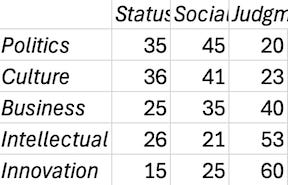
By the way, I asked 3 LLMs to score the relative importance in 5 areas, for influence/impact of your leadership bid, of your status, your social skills, and your judgement re the actual topic of your leadership (e.g., good ideas, arguments, slogans, designs, plans, group strategies). Their median % estimates:
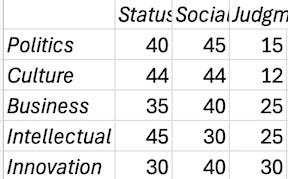
Then I asked them to focus on “who is selected or is influential in the short run, not who becomes famous in the long run”, and to consider if they have any concrete basis for seeing judgment as mattering more re intellectuals and innovation. Their revised median % estimates:
It seems that we are biased to neglect these problems.
Well then we just need to increase your status, Robin! [Seriously, you're a professor at a first-rate university; you're not low status.]
It sounds like there needs to be a market where people with big ideas hire high status people to push those ideas as though they were there own yo affect policy.
Which sounds pretty much exactly what the Davos crowd and George Soros are accused of doing. It might be that you are not the first one to realize this :)