

If futarchy ends up as successful as I hope, the world will have to choose explicit ex-post-measurable goals to assign to their governments, and political talk and activism will turn to focus more on fighting over such goals.
I can see some pretty safe options: stock value for firms, property values for cities, and maybe some mix of property values, GDP, and tradable citizenship prices for nations. But I suspect many will find these uninspiring, and instead push for metrics tied to concepts citizens can more easily and emotionally embrace. What might those be?
Some polls of mine ranked 16 possible goals re “what you most fundamentally want to get for your self, associates, & community”. From top rank on down, I found: Liberty, Meaning, Health, Happiness, Vitality, Adaptiveness, Insight, Innovation, Econ Efficiency, Legacy/Fertility, Transcendence, Power, Authenticity, Connection, Pleasure, Respect. (I tried a longer list at first, then cut back to these.)
Then I ran 7 sets of 8 polls each (1 2 3 4 5 6 7) asking folks to rank these 16 goals re 7 different scopes: your “self right now at this moment”, lifetime self, close associates, community, nation, world, and “all creatures anywhere at any spacetime place in the multiverse”. Here are their priorities:
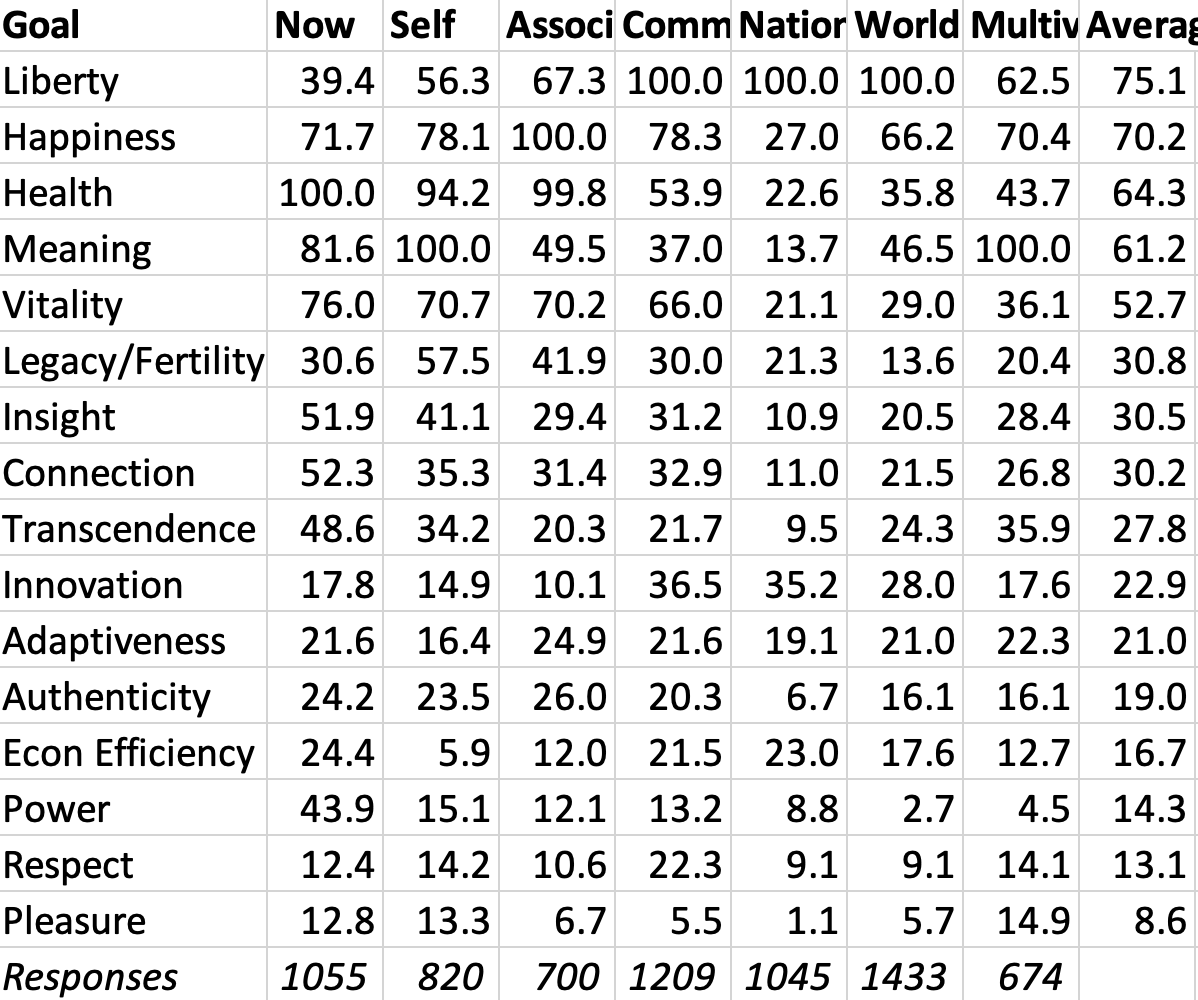
Note that the top for each scope is always set to 100, and for nation that top (liberty) is far above its others, suggesting that 100 for nation is a higher priority than 100 for other scopes. What can we learn from this?
First, it seems we humans just don’t know our goals very well. Five quite different goals have an average priority at least 70% of the top: liberty, happiness, health, meaning, and vitality. That’s a lot closer than I usually find in priority polls. Furthermore, two goals widely believed by scholars to be quite strong in humans, respect and pleasure, are the bottom two on average, suggesting poll respondents are in substantial denial about their goals.
Second, goal priorities depend substantially on the scope of the unit considered. The widest scope multiverse is a bit weird, acting like the very narrow scope self for meaning, happiness, legacy, transcendence, and respect, but not for health, vitality, pleasure, insight, connection, and power. For all the other scopes, priorities seem to vary smoothly with scope breadth. Thus futarchies would likely adopt predictably different goals depending on the breadth of the social units they govern.
Several goals peak in priority at the nation scope, including liberty, innovation, and econ efficiency. And as the highest goal overall is the one that is very high for nation, this suggests that people (or at least my followers) like to join together into nation sized units, and then pursue liberty most of all there. Liberty is a concept we see as applying most strongly to nations; we want our nation to be free from outsiders, and its citizens to be free from internal powers.
The respect goal peaks at community scope, while the goals of vitality and authenticity are strong up to that scope, and then decline for larger scopes. Happiness peaks for close associates, while health, legacy, and pleasure are strong up to that scope and decline after.
Meaning and pleasure peak for our lifetime self, while the following goals all peak at our narrowest scope of the momentary self: insight, connection, transcendence, power, and econ efficiency. Strange that people see insight and transcendence as things they want selfishly, only for themselves.
Adaptiveness is unusual in not depending much on scope, and in dropping a lot in priority from those first polls to these new polls which ask about specific scopes. While we might expect the goal of adaptiveness would be selected for in the long run by cultural evolution, that selection process may take a while.
In my presentations of futarchy, I have usually assumed that we would use democracy to set its goals. I’ve done this not because I recommend that per se, but as it makes sense to present minimal change proposals, leaving as much as possible unchanged. I’m not against further change, but think that min change proposals best help people to consider the value of any proposal.
Added Oct8: I fit a stat model to all responses for a particular scope that predicts the ratios of % of responses for each answer in terms of ratios of priorities.
This is really interesting.
It would be helpful if you explained exactly what you polled better than you have here - it's not clear how you converted "ranking" (if that's what you polled) to numbers 0..100. And while you're clear about the timing for "self right now", "lifetime", and "all spacetime", it's not clear what time period was ranked for the other scopes.
But this offers a glimpse into possible political controversy and disagreement under Futarchy. People may argue over time scale and scope. (Some will think high property values are *bad* as they make housing more expensive.) Exactly why 'multiverse' seems to elicit different priorities than 'world' seems worth studying.
Of course the values your respondents ranked are subject to differing interpretations - did you define 'liberty' in any way? I see personal liberty as important but 'national liberty' (not being ruled by outsiders) as irrelevant except as it influences the other values. Maybe I'm an outlier. 'Econ efficiency' seems a means to an end, not an end. You could say the same about some of the others.
I like the as ambition of this work. But two observations. 1. As Henry Ford may have said, "if I asked people what they wanted, they would have wanted a faster horse." I've spent a lot of my working life asking people what they want/need and I agree with Henry that people are very short sighted. You need to coach them a lot before they can imagine a better future and answer the question intelligently. 2. Even as an Australian, which is culturally pretty close to being north American, I get a strong US-centric vibe from the list. US public discussion priorities liberty like no other public discourse I can think of. People who don't have peace and safety will usually put this at number 1, well ahead of liberty. Equality is also a big deal in non-US discourse, as is respect for tradition and holiness in some places.