

The world economy grew by a factor of twenty over the last century, and five over the prior century. Will it grow that fast again over the next century or two? Or maybe even faster, if we achieve and deploy human level AI? Or will we slow and fall, as did the Roman Empire, or the Han Dynasty at roughly the same time, or pretty much all known civilizations in history? There could hardly be a more important question about the medium term future.
I see two general approaches taken to this question. Some see the strongest evidence as lying in specific recent trends they see as suggesting either growth or decline. (E.g., AI-based optimism, or ecology-based pessimism.) In a poll, roughly 46% prefer this specifics approach, equally split between growth and decline. The other 54% prefer one of two general long-term trends, one suggesting growth, the other decline. However, while roughly 62% of these folks see the growth-suggesting trend as the stronger evidence, that seems just clearly wrong to me. Let me explain.
The growth-suggesting trend uses our best estimates for the world economy over the last ~20Kyrs, which mostly tracks world population until the last few centuries. This trend shows a roughly exponential rise, except that the growth rate increased dramatically ~10Kya and ~300ya. The biggest documented decline in that trend was the 1300s Black Death that killed ~16% of world, and cut even less of its economy.
The decline-supporting trend is the consistent fall of past “civilizations”, i.e. regions of people with who share culture and high levels of trading, talk, travel, and governance. Such regions tend to rise and fall together, while separate co-existing civilizations have much weaker correlations re their rises and falls. The median % decline of ten past civs (Rome, Maya, Khmer, Han, Byzantine, Mesopotamia, Inca, Aztec, Egypt, Indus) was >80%, after a median of ~2.5 centuries from peak to trough.
The world trend suggests continued growth, with a decline of even 16% seeming pretty unlikely in the next few centuries. But if we see our world today as a single integrated civ, then the civ rise and fall trend suggests that we will suffer a maybe ~80% decline soon. How can we choose between these different framings?
The obvious answer, I think is to find the simplest model that predicts both of these past trends, and then use that model to predict the future. And that simple model also seems obvious: civs arise randomly, then consistently rise and then fall, and have a changing rate at which they appear and/or a changing height to which they rise, so as to predict the historical rise in total world product. And as % of world product within the then-largest-civ has been rising over time, we should posit that this peak civ height has been rising faster than has the world economy.
This integrated model predicts both historical patterns, the rise and fall of civs, and a mostly steady rise of the total world economy. And this model predicts a big fall in the next few centuries. So that’s my prediction too, based both on this general trend analysis, and on my more specific analysis of the problem of cultural drift. An 80% decline could bring world population down to ~1.6B.
To avoid this conclusion, some try to deny that our world today counts as an integrated civ, as it doesn’t have a single ruler over it all. The US dominating the world for as long as it had doesn’t count, in their view. But the key concept of a civ is whatever makes its internals correlate in their rise and falls. And that seems to have a lot more to do with sharing trade, travel, and talk than it does shared governance.
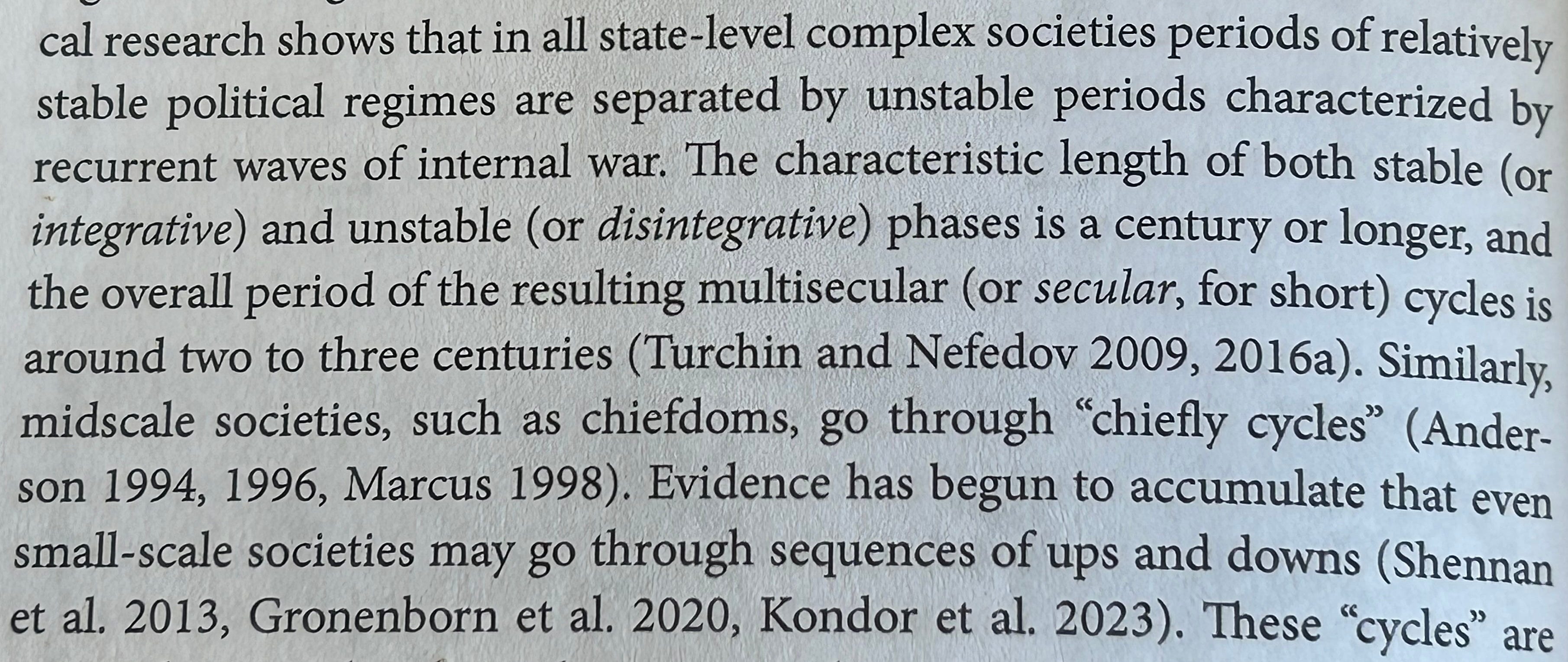
Others say that a sample of only ten civs is too small to draw any conclusions from. Yet the size of human groups has grown by seven orders of magnitude over humanity’s time, and all of those different group sizes seem to show patterns of rise and fall. (See added to post below.)
Still others try to deny that past civ patterns are relevant to our civ, though past world growth trends remains relevant. After all, those past civs didn’t have rock & roll, microwave ovens, or the journal Nature, or any of a thousand other specific features of today’s world civ. But of course all those older civs also each had a thousand unique features, which didn’t save them.
Also, if you survey the top ten theories offered for why civs fell in the past, the only one that much less plausibly applies to us today is invasion by outsiders. All the rest could happen to us.
Added 26Sep: Turchin Great Holocene Transformation, p92, on rise/fall across scales:
Is it reasonable to apply historical lessons about the rise and fall of civilizations to the present case of a single integrated civilization?
Historically those rapid rises and falls were enabled by inter-civ competition: The Romans stole market share from others, held onto it for a while, and in turn it was stolen from them. C'est la vie.
That all changes when there's a monopoly. Maybe that monopoly rots from within over time, or maybe it doesn't, but I don't see how lessons learned from prior civs would necessarily pertain. Unless that is we have a civ of AIs or aliens or Mars-based humans coming to eat our lunch.
It is almost irrelevant which scenario we choose unless we attach an at least approximate timeline to it. Will another 200 years pass like the last 200, ending in collapse? By then, GDP per capita in the world’s leading economy could reach around one million dollars. (In 1825, it was the equivalent of $3,500 in the UK; in 2025, it is $60,000 in the US — a 17-fold increase in two centuries.) Or will AI first accelerate growth, and only then comes the decline? In that case, it would be many times higher. And when collapse does come in 2200, will it be the whole of humanity, or “only” Earth?
Nothing meaningful can be said in either direction without specifying what causes the change in the growth rate. In the absence of this, the most reasonable thing is to assume that it will remain as it has been so far — a base rate of annual productivity growth of 1.2–1.3 percent, with occasional accelerations.