

I asked a set of polls, and 3 LLMs (ChatGPT,Claude,Gemini) to rate the relative explanatory power of the following 16 causes of cultural change for the two periods 1700-1900 and 1900-2025. I asked polls re picking 1 of 4 causes, and asked LLMs to think of 50 culture changes in each period, score each cause on a 0-10 scale re each change, and then add up scores per cause. (I also asked Grok, but its rounded sums suggested that it lied about generating detailed scores.)
Elite Youth Culture - Rise of high school and college, youth culture and movements; changes had to appeal to elite youths.
Lazy/Myopic/Selfish/Pleas - Revert to be more lazy, myopic, selfish, pleasure-oriented.
Forager Reversion - Revert to forager styles: more art, leisure, democracy, and equality, and less religion, fertility, and domination.
Individualism, Authentic - Rise in status of individualism, authenticity: think for yourself, follow your heart, be true to yourself.
Innovate, Explore, Create - Rise in status of innovation, exploration, creativity.
Abstract Concept, Reason - Rise in status of more abstract concepts and reasoning.
Rich, Safe, Trade/Talk - Stuff that appeals more to people who are richer and safer, with more/wider talk/travel/trade.
Merging Culture Appeal - Stuff accessible to and can appeal to the wide range of cultures merging in this period.
Fashion/Elite Displace - Rise in fashion as change process; changes must appeal to elites seeking to displace other elites.
Media/Word Legibile - Legibility of change symbols to spread via words and mass media.
Big Org/Inst. Codify - New stuff can be seen and codified by our new large orgs and institutions.
Sounds Good, Short-Run - Prefer stuff that sounds good and shows visible short-run gains.
Visible Sacrifice - Visible sacrifices show allegiance; we figure we value what we’ve seen recent big visible sacrifices for.
Lose Religion/Fragment - Loss of religion and traditions as core cultural glues induce fragmentation, divergence.
Low War/Internal Polarize - Less war and outside threats make more wealth inequality, stronger internal conflict, polarization.
Adapt Tech/Demography - Sensible adaptation to other behavior changes, not of culture type, eg, tech, demographic, and business practices.
Here are priority out of 100 poll scores, and median of the 3 LLM sum scores:
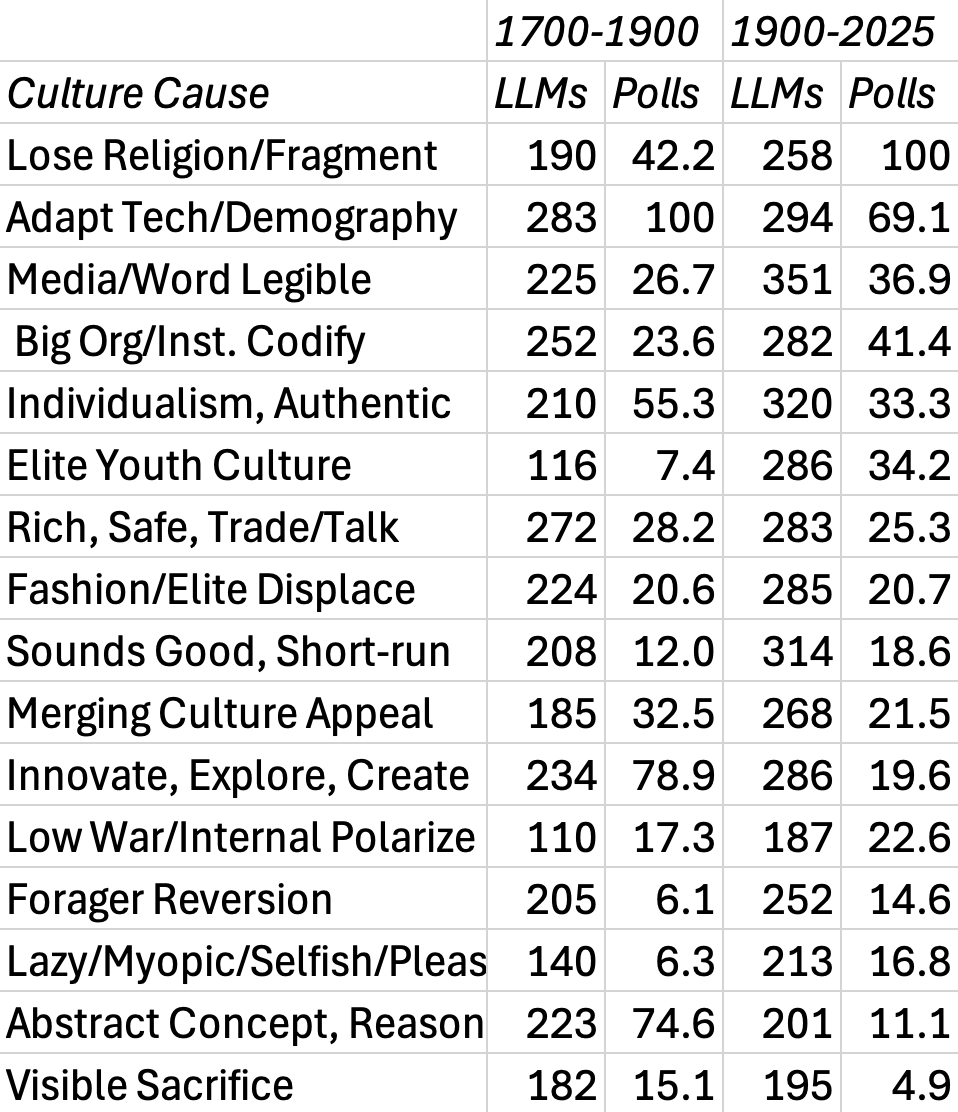
Scores don’t vary that much, correlations between sources are weak, and I overall disagree a lot with them. From which I conclude that either this is quite hard to figure out, and/or there really were quite a few strong causes.
The problem with history is, can we really define "explanatory power" when N=1? People weave compelling stories about why lead plumbing caused the downfall of Rome, etc. but it always feels just-so to me. I wonder if it says more about the biases of the author (and their audience) than it does about Romans.
The randomness of LLM results may just be its peculiar way of saying, "I don't know." RLHF strongly penalizes the models for not giving answers.
Would be easier to parse if LLM scores and polls were on normalized scales.