

I’m still early in thinking about culture, and only recently thought to ask about the relative importance of different cultural forces, and how that might have changed over time. So I collected eight rough labels of “cultural forces”. This set doesn’t obviously “cut nature at its joints”, as many of these are plausibly forces underlying many of the others. But they are a start.
I asked both 7 LLMs and polls on X which of these eight were the stronger forces, both in 1700 and 2025. Here are the poll priorities (max 100) and the median LLM rank:
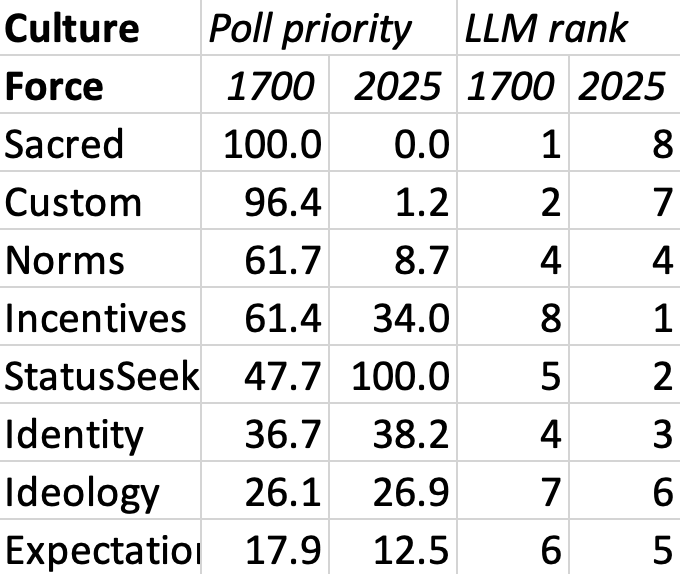
]According to polls, there’s been a dramatic fall in the strength of sacred, custom, and norms, and a big rise in status. LLMs disagree by saying norms didn’t change, and that expectations matter more than polls think. But the biggest disagreement is while polls say incentive strength fell substantially, LLMs saying incentives moved from being weakest in 1700 to being strongest in 2025. In all this polls seem more right than LLMs to me.
As we economists focus overwhelming on incentives, it is striking to me to see them rated here as greatly outclassed by other cultural forces.
I think this confuses categories. Status/honor changes depending on what one finds sacred. The idea that people in the past did not seek status/honor seems insane; one of the main plot points in the Iliad (Achilles' refusal to continue fighting) resolved around status/honor. Money, in turn, often confers prestige/status/honor.
I understand that these categories are separate, but often everything simply flows together. What is honorable also often pays well; norms and custom dictate what is honorable.
Further, in the economist's narrow sense, “incentives” usually means monetary incentives: wages, bonuses, promotions, fines, formal rewards, penalties, etc.
But in a broader sense, status is an incentive, sacred reward/punishment (heaven/hell, honor/shame) is an incentive, norm enforcement (gossip, ostracism, praise) is an incentive. If we talk in that broad sense, incentives have always been enormous, because that is how life works.
Maybe the structure of motivation--people wanting survival, status/honor, money, approval, etc.--is pretty stable. What earns those things, and what language we use to describe them, changes.
Why do you agree with the polls over LLMs on incentives?