

I’ve devoted a lot of attention on this blog over the last year to near-far effects, officially “Construal Level Theory.” My summary: all near aspects tend to bring other near aspects to mind, and all far aspects tend to bring other far aspects to mind. The aspects:
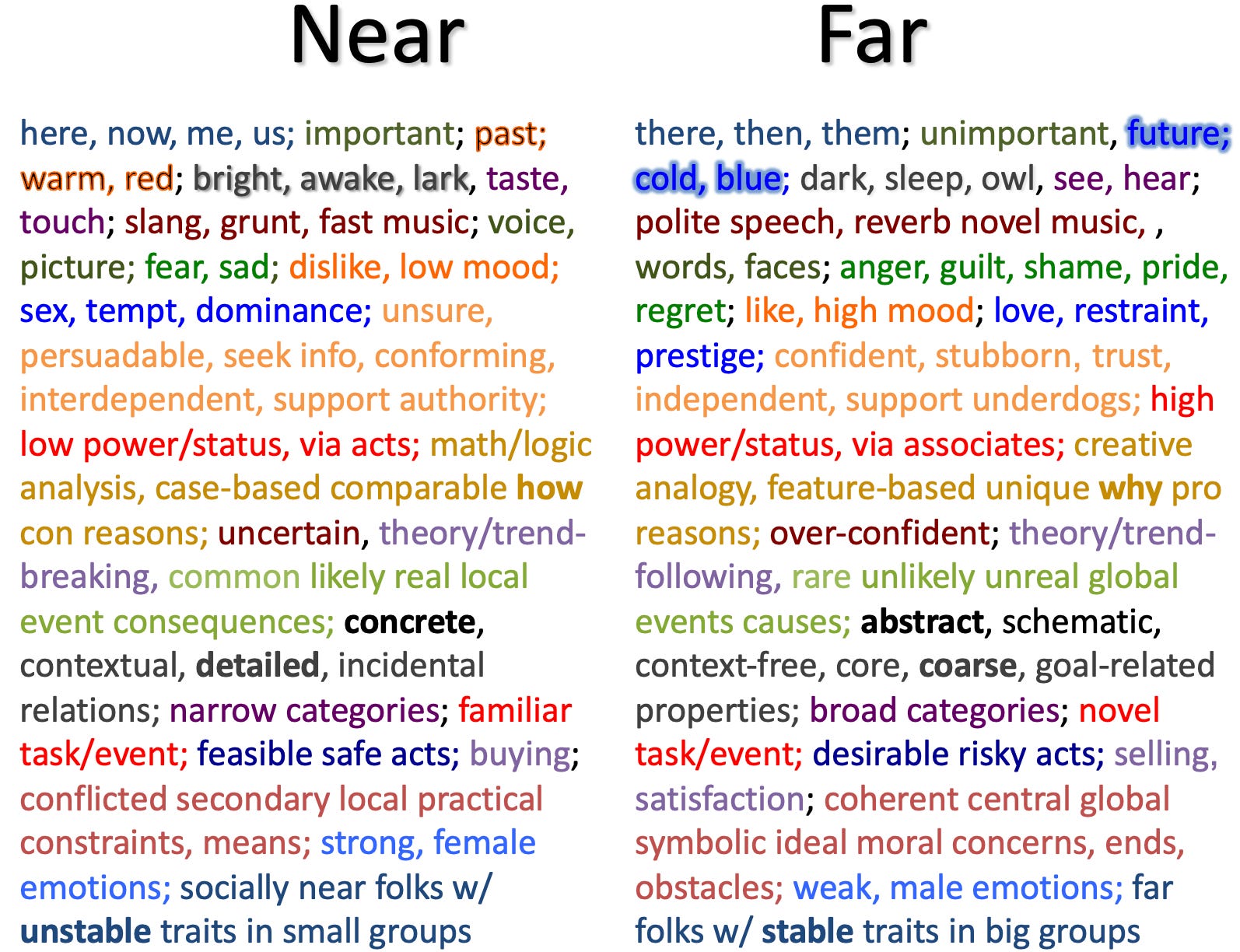
Its authors, Trope and Liberman, have just published an advanced review of the subject, which I heartily recommend. They summarize:
The fact that something happened long ago does not necessarily mean that it took place far away, that it occurred to a stranger, or that it is improbable. Nevertheless, as the research reviewed here demonstrates, there is marked commonality in the way people respond to the different distance dimensions. [Construal level theory] proposes that the commonality stems from the fact that responding to an event that is increasingly distant on any of those dimensions requires relying more on mental construal and less on direct experience of the event. … [We show] that (a) the various distances are cognitively related to each other, such that thinking of an event as distant on one dimension leads one to thinking about it as distant on other dimensions, (b) the various distances influence and are influenced by level of mental construal, and (c) the various distances are, to some extent, interchangeable in their effects on prediction, preference, and self-control.
Since we are more idealistic in far mode, our ideals favor and admire far more than near. Trope and Liberman agree:
It is worth noting that both collective and personal human development are associated with traversing increasingly greater distances. The turning points of human evolution include developing tools, which required planning for the future; making function-specific tools, which required considering hypothetical alternatives; developing consciousness, which enabled the recognition of distance and perspective taking; developing language, which enabled forming larger and more complex social groups and relations; and domestication of animals and plants, which required an extended temporal perspective. Human history is associated with expanding horizons: traversing greater spatial distances (e.g., discovering new continents, space travel), forming larger social groups (families vs. cities vs. states vs. global institutions), planning and investing in the more distant future, and reaching farther back into the past. Human development in the first years of life involves acquiring the ability to plan for the more distant future, consider possibilities that are nonpresent, relate to and take the perspective of more distant people (from self-centeredness to acknowledging others, from immediate social environment to larger social groups). Although the areas of evolution, history, and child development have different time scales, research in these domains seems to converge on the notion that transcending the present requires and is enabled by the human capacity for abstract mental representation.
The human mind is amazingly powerful, and our far capacities are essential to our powers. But while far minds offer flexibility, perspective, and self-control to enable civilizations, far minds are also more deluded and hypocritical. By becoming more far, civilized humans have become all the more: homo hypocritus.
Thanks
I don't understand what made it go away, but I've added it back in.